Andover Concert Series
Performed at:
Seven Classical Concerts
Season 79
September 2025 to April 2026
Thu 25 Sep 2025 7:30pm
Duality
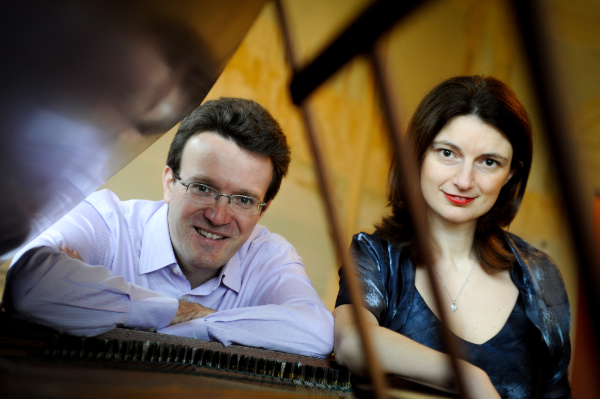
Emma Abbate & Julian Perkins
4 Hands, 1 Piano
Let's Dance!
| Grainger | – | Let's Dance Gay in Green Meadow |
| * Mozart | – | Fantasia in F minor |
| Schumann | – | Kinderball, 6 leichte Tanzstücke, |
| Warlock | – | Capriol Suite |
| Fauré | – | Dolly Suite |
| Dvořák | – | Two Slavonic Dances |
| Barber | – | Souvenirs |
* Change from the printed 4-fold
Duality
Emma Abbate & Julian Perkins

Emma Abbate and Julian Perkins have given duet recitals at venues including the Royal Opera House, St George’s Bristol, St John’s Smith Square, Hatchlands Park, the Russell Collection and for the Mozart Society of America. Praised for their ‘‘impressive sensitivity’’ by Early Music Reviews and for telling ‘‘a totally convincing story with every piece’’ by The Arts Desk, their recordings have received five-star reviews in BBC Music Magazine and Het Nieuwsblad. Their varied discography includes Mozart’s complete sonatas for keyboard duet on period instruments, Weber’s complete piano duets on an original Viennese fortepiano, as well as Tournament for Twenty Fingers featuring works by British composers from the twentieth century. Their latest disc is Summer Dreams which brings together the complete works for piano duet by three major American composers: Edward MacDowell, Amy Beach and Samuel Barber. They have both been elected Associates of the Royal Academy of Music in recognition of their ‘significant contribution’ thus far to the music profession.
This duo is now called Duality.
YouTube Channel
Emma Abbate
Italian pianist Emma Abbate enjoys a demanding career as a piano accompanist and chamber musician. Described as "an amazingly talented pianist" by the leading Italian magazine Musica, she has performed in duo recitals for international festivals and concert societies throughout Europe and at UK venues such as the Wigmore Hall, Southbank Centre and the Aldeburgh Festival. She also regularly broadcasts on BBC Radio 3 and has recently presented an episode of Inside Music.
Emma is making a series of acclaimed recordings devoted to 20th century Italian vocal chamber music, the latest of which is the world-première Franco Alfano: Songs with the leading Italian soprano Anna Pirozzi. Previously, Emma has released Sera d'inverno: Songs by Ildebrando Pizzetti with mezzo-soprano Hanna Hipp, and Mario Castelnuovo-Tedesco: Shakespeare Sonnets with bass-baritone Ashley Riches. A keen advocate of contemporary music, Emma has also released two discs devoted to works by Stephen Dodgson that include his piano quintets with the Tippett Quartet.
Based in London, Emma is a professor at the Guildhall School of Music & Drama and a staff coach at the Royal Opera House, Covent Garden.
Julian Perkins
Julian Perkins is Artistic Director of the Portland Baroque Orchestra in Oregon, USA. Based in the UK, he is also Artistic Director of Cambridge Handel Opera and Sounds Baroque. He performs regularly at the Salzburg Festival, has directed groups ranging from the Academy of Ancient Music to the Orchestra of Welsh National Opera, and featured as soloist in concertos with groups such as the Royal Northern Sinfonia, Orchestra of the Age of Enlightenment and Florilegium.
Julian has appeared as solo harpsichordist / fortepianist at the Bayerische Staatsoper in Munich, Royal Opera House, Covent Garden and Welsh National Opera, among others. He features regularly on the BBC Early Music Show and In Tune, and has performed as a soloist at London’s Wigmore Hall, New York’s Lincoln Center and Sydney Opera House. Shortlisted for the 2021 Gramophone Award for his recording of Eccles’ Semele, Julian's playing and conducting has been praised for its ‘‘demonic intensity’’ (BBC Music Magazine – Recording of the Month) and ‘‘fluid and natural pacing’’ (Gramophone – Editor's Choice), conducting ‘‘as if every bar means the world to him’’ (Opera Disc of the Month). In August 2023, his latest solo clavichord disc, Handel's Attick, was Instrumental Choice in BBC Music Magazine.
Presented by:
Andover Music Club
Registered Charity No. 1016967
Presenting live classical music to
a wide audience since 1945
Patron:
David Owen Norris MA (Oxon),
FSA, FRAM, FRCO, FRNCM.